

Maatra: a family health platform built for the long run
Care happens across hospitals, clinics, laboratories, pharmacies and homes. The information rarely travels with the family as one coherent history. Maatra is Moonjar's first product, and it exists to close that gap.
Built for what happens after the appointment
Someone has to remember the medicines, book the follow-up, find the old report, track what changed and brief the next doctor. For an ongoing condition or an ageing parent, that responsibility does not end.
Maatra is built for the family member carrying it.
One family, one health history
Maatra is organised around the family rather than a set of unconnected individual accounts. A user maintains health information for themselves and for the people whose care they help manage, and controls who within the family can see each person's information.
As records, medicines, readings and health events accumulate, each family member's history gets deeper and more useful.
How Maatra works
-
1
Information arrives the way it already does
Prescriptions, reports and records come in through the app, as files, by email and over WhatsApp. Families do not have to reorganise anything before they can start.
-
2
Documents become information
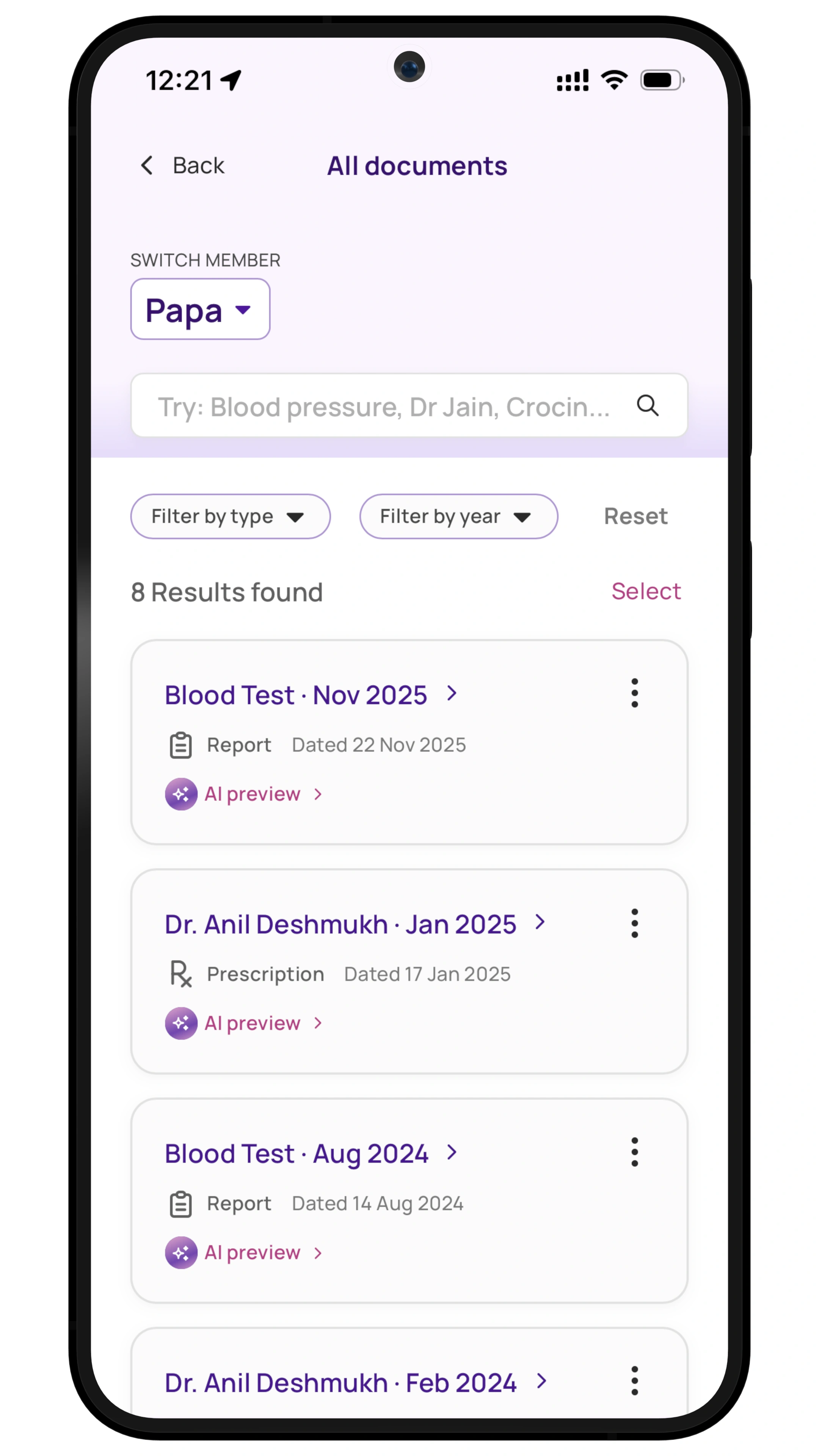
Maatra reads each record, identifies whose it is, and extracts what is inside. The original stays. The structured data powers everything else.
-
3
The history builds
Records, medicines, readings and health events stay connected to the right person over time. One report tells you what happened. A history tells you what changed.
-
4
The history gets used
Families search it, compare it, summarise it and act on it. The result is a working health memory for the household.
What families can do with Maatra
Find anything, instantly. Records are searchable and stay attached to the family member they belong to. No hunting through folders, inboxes or WhatsApp threads.
See what is changing. Laboratory results are organised by parameter, so earlier readings, reference ranges and movement over time sit together. Blood pressure, blood sugar and weight can be logged alongside them.
Keep medicines straight. A current view of what each family member takes, with a record of what changed and when. Medicines read from a prescription are confirmed by the family before they are added.
Walk into the next appointment prepared. A Health Summary pulls history, medicines, recent events and laboratory results into one view that is easy to review and share.
Be ready in an emergency. Allergies, conditions, current medicines, devices, surgeries, emergency contacts and insurance become an Emergency Card that opens in seconds.
Stop relying on memory. Reminders for medicines, appointments, tests and vaccinations, each tied to the person they belong to.
Share the load. Multiple profiles, with access granted member by member, so responsibility can be shared without exposing everything to everyone.
How we use AI
Maatra runs a hybrid architecture built for the reliability that health data demands. Probabilistic models do the work they are good at. Everything clinical or analytical is computed deterministically.
Multi-modal ingestion. Our proprietary ingestion engine normalises heterogeneous inputs into structured, longitudinal family health profiles: printed diagnostic reports, laboratory PDFs, scanned documents and handwritten clinical notes, resolved to the correct family member and connected across time.
Deterministic clinical logic. Health indicators, trend evaluation and metric thresholds are computed through rule engines developed under clinical advisory, not through language generation. The system does not infer diagnoses or recommend treatment.
Controlled language delivery. Generative models operate only at the synthesis layer, turning verified data into clear updates for families. They phrase conclusions the system has already reached rather than reaching them.
Separating data structuring from clinical evaluation is what allows Maatra to scale document understanding without putting judgement in the hands of a model.
Designed for sensitive information
Maatra is built around explicit consent, role-based access and user control over family health information. Records are encrypted in transit and at rest, and the platform is hosted in India, with access and processing designed around Indian data protection requirements.
These decisions shape how families, permissions, documents and AI processing work.
Built for Indian conditions
Indian families rarely hold one complete, portable health record. Care spans independent doctors, hospitals, laboratories and pharmacies, and the information exists as PDFs, photographs, handwritten prescriptions, paper reports and WhatsApp messages.
Rather than wait for providers to publish structured data, we help the family build continuity from what is already in its hands.
Where Maatra is going
Maatra began with a fundamental conviction: a family's long-term health should never depend on fragmented memory, lost paperwork, or the burden of one person keeping track of what comes next.
We are building the continuity layer for family healthcare, a living health context that grows richer over time and stays with the family across doctors, hospitals, diagnoses, and generations.
- Context across encounters: Connecting past health history with new information, so important context is available when seeing a new specialist, managing an ongoing condition, or dealing with an emergency.
- Continuity over time: Moving beyond storing records to help families keep track of follow-ups, understand changes in health, and manage increasingly complex care over months and years.
- A health history that compounds: Building a longitudinal record that preserves what the family has learned over time, rather than starting again with every new doctor or healthcare encounter.
Whenever care becomes complicated, Maatra is designed to be the persistent thread that holds the history together, preserves important context, and gives families a clearer view of what has happened and what needs attention next.
Explore Maatra at maatra.health →